A flashlight is one of those pieces of everyday-carry gear that looks simple until you try to buy one. The packaging says 2,000 lumens. A competing model boasts a bigger beam-distance figure. Another claims hours of runtime. It is easy to assume the biggest number wins. It usually does not.
The useful question is not simply how bright a flashlight can get. It is where its light goes, how long it stays useful, and whether the maker’s numbers describe a quick burst or an everyday working mode. That question became even more important after the Portable Lights American Trade Organization (PLATO) announced a revised portable-light performance standard on February 2, 2026. Named ANSI/PLATO FL 1-2025, the revision introduced standardized reporting for short-duration turbo or boost output.
Here is how to read flashlight specifications without getting lost in the marketing.
Lumens vs. candela: different numbers, different jobs
Lumens describe total light output
A lumen (lm) is a unit of luminous flux: the overall amount of visible light emitted by a source. Lumens help describe how much light a flashlight produces, but do not tell you how it is distributed. One light can spread its output across an entire workbench; another can concentrate comparable output into a tight hotspot down a trail.
Think of a hose nozzle. The same flow can create a broad spray or a narrow stream. How much water you have and where you send it are separate questions. In flashlight terms, the optics help answer the second one.
Candela describes intensity in a direction
Candela (cd) measures luminous intensity in a particular direction. The peak candela listed on a flashlight specification sheet reflects the strongest part of the beam, usually its central hotspot. The National Institute of Standards and Technology explains the unit’s scientific basis.
Higher peak candela can mean more reach, but it does not guarantee a better light for every use. A tightly concentrated beam can help across a dark field yet feel awkward when all you need is to find a dropped washer under a workbench. Two lights both rated at 800 lumens may have very different beam shapes and practical uses.
Flood versus throw: beam shape matters
A flood beam spreads illumination over a broad area. It suits close work, moving around a room, or finding gear inside a tent. A throw beam concentrates more light into a narrower hotspot, making it better suited to distant targets. Many general-purpose EDC lights balance a recognizable hotspot with enough surrounding spill to keep your bearings.
Reflectors, lenses and collimators shape the beam. That is why flashlights with similar emitters and lumen ratings can perform very differently.
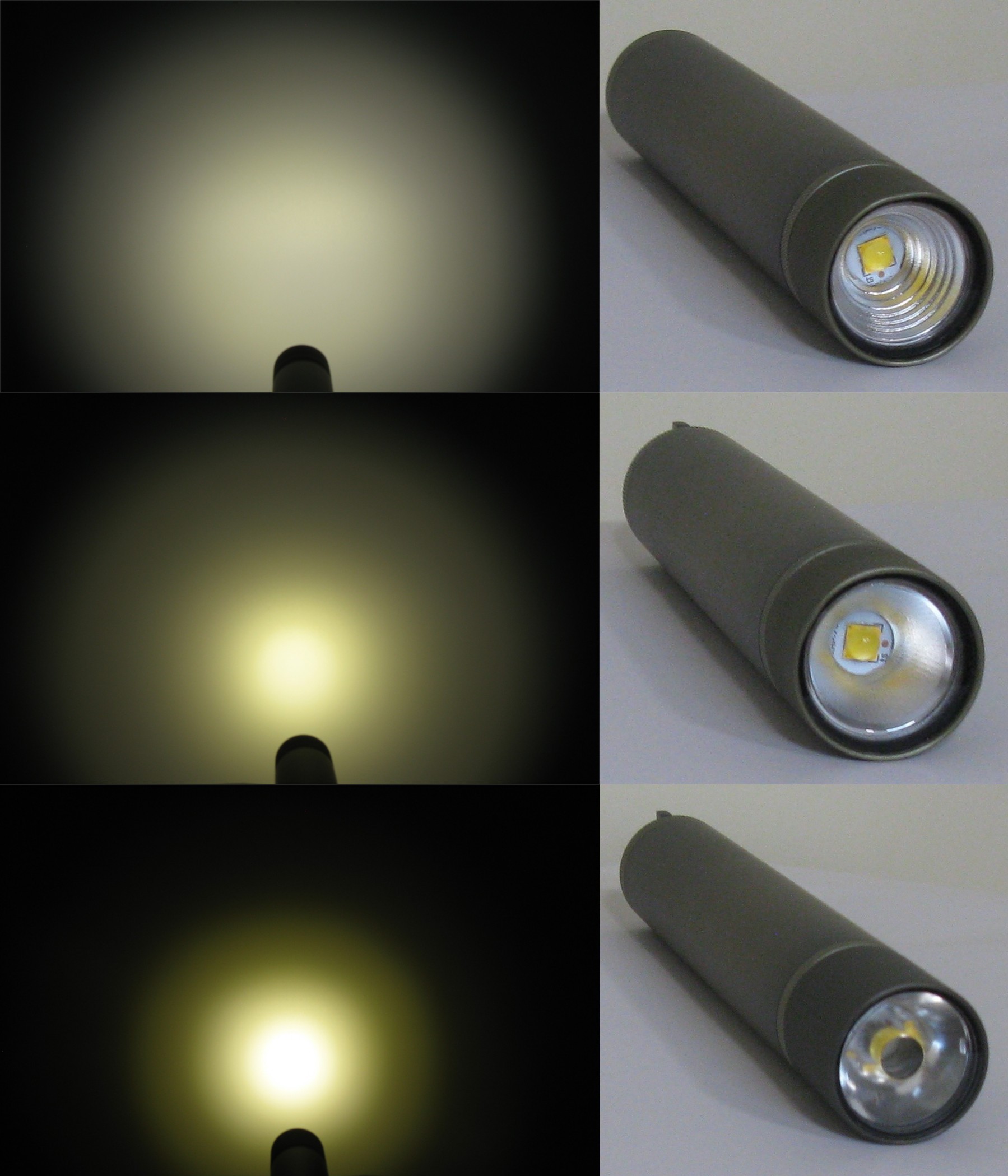
Before comparing specifications, ask: Do I need to illuminate a wide area nearby or pick out something farther away? That determines whether flood, throw or a balanced beam belongs at the top of the list.
What beam distance really means
Under the ANSI/PLATO FL 1 method, beam distance is tied to a defined illumination threshold of 0.25 lux at the target. That gives manufacturers a shared measurement method; it does not promise you will clearly identify every object at the distance printed on a package. Petzl’s technical explanation discusses the threshold.
Beam distance in meters = square root of (peak candela / 0.25). A hypothetical 8,000-candela beam thus corresponds to about 179 meters; a 20,000-candela beam corresponds to about 283 meters. These are formula examples, not measurements of actual products.
Real visibility depends on rain, mist, ambient light, the surface and color of the object, and the observer. Treat beam distance as a comparison metric—not guaranteed identification range.
Runtime: why the headline number can mislead
Suppose a flashlight advertises 1,000 lumens and five hours of runtime. You might picture a constant 1,000 lumens for all five hours. That could be wrong.
For ordinary operating modes, the established FL 1 runtime method ends when output falls to 10% of an early measured output level. PLATO’s October 2026 testing guidance confirms that ordinary-mode testing retains this general approach. A mode referenced at 1,000 lumens could therefore reach the runtime endpoint at roughly 100 lumens.
The shared endpoint helps compare claims, but it does not reveal the brightness curve between the start and the finish. Some lights step down substantially before their listed runtime expires. Look for the runtime of the medium mode you actually expect to use, and consult output-over-time charts when manufacturers or independent reviewers publish them. Temperature and thermal management can affect high-output behavior.
What changed with ANSI/PLATO FL 1-2025?
Although its name includes 2025, PLATO announced publication in February 2026. The revision retains ordinary-mode performance testing while adding methods and markings that better distinguish emerging portable-light technologies, including short turbo bursts. Its scope also addresses more varieties of portable lights, including headlamps and area lights.
Turbo and boost have a dedicated method
PLATO’s technical change summary describes testing short-duration elevated-brightness modes. Output, peak intensity and distance are measured between one and ten seconds after activation. Runtime for this method runs until output falls to 90% of the highest reading within the first ten seconds.
That is different from the ordinary-mode 10% runtime endpoint. New marking conventions, including a stopwatch-style symbol, are intended to communicate the distinction. A 4,000-lumen turbo burst is not the same thing as sustained 4,000-lumen work lighting. Nor should shoppers assume that all manufacturers have already adopted the revised standard or obtained independent verification of their claims.
Dust and water claims deserve closer reading
The revised FL 1 edition also introduces dust-ingress markings for IP5X and IP6X and changes its treatment of IPX8 water immersion testing, allowing defined conditions for depth and duration. The wider IP-code framework is described in IEC 60529.
In an IP code, the first position concerns solid-particle ingress and the second concerns water. An X means a rating is not specified in that position; it does not necessarily indicate a failed test. For IPX8, the maker’s actual stated immersion conditions matter. Neither a dust-resistance label nor the word “waterproof” makes a flashlight indestructible.
An EDC flashlight checklist that actually helps
- Match beam shape to the job. Close-up repairs and walking favor a broad, comfortable beam; distant viewing can benefit from more concentrated intensity.
- Compare working modes. Read output, runtime and distance for a setting you will use regularly, not only the turbo headline.
- Check the brightness curve. Output-over-time data can be more revealing than a peak and a runtime endpoint.
- Consider everyday handling. Clip, size, weight, controls and accidental-activation protection may matter more than a few hundred extra lumens.
- Choose a practical power setup. Account for charging access, battery availability and manufacturer handling instructions.
- Read the complete IP claim. Match the specific dust and water conditions to your environment rather than trusting marketing adjectives.
There is no single ideal light for every pocket. An outdoor thrower may frustrate a bench technician; a compact close-range light may not reveal distant trail features. The point is a beam you can actually use, not a specification you can boast about.
A final safety note: powerful beams can dazzle people and high-output compact lights can become hot. Avoid shining strong beams into anyone’s eyes and follow the manufacturer’s operation, charging and storage guidance.
Frequently asked questions
Is a 1,000-lumen flashlight always brighter than a 500-lumen one?
It produces more total visible light at the stated measurement point if both ratings are comparable. But a 500-lumen light can have higher intensity in a distant hotspot if its beam is much narrower.
Is higher candela always better for EDC?
No. More peak candela often helps with reach, but a broader, less intense beam may be more comfortable for close tasks. Choose by normal viewing distance.
Did FL 1-2025 invalidate earlier ratings?
No. It adds and updates methods, particularly for short elevated-brightness modes. Check which edition and mode each manufacturer used rather than assuming every specification has been updated.
The bottom line
A flashlight is a tool, not a scoreboard. Lumens describe total visible output. Candela describes directional intensity. Beam distance represents a standardized low-illumination threshold, not guaranteed identification range. And runtime means little without knowing the mode and measurement endpoint.
The FL 1-2025 revision, announced in 2026, makes short turbo bursts easier to distinguish from ordinary operation. That is a meaningful improvement for shoppers who want useful specifications instead of impressive packaging.
Explore more useful equipment coverage in The Precision Journal, including Knife Steel Without the Hype: What Really Matters.
Sources
- PLATO: Revised ANSI/PLATO FL 1-2025 standard publication (February 2026).
- PLATO: What changed and why it matters.
- PLATO: Getting the testing right (October 2026).
- NIST: Candela.
- Petzl: Measuring lighting performance under ANSI/PLATO FL 1.
- IEC 60529: Enclosure ingress protection.
Photo credits and editorial disclosure
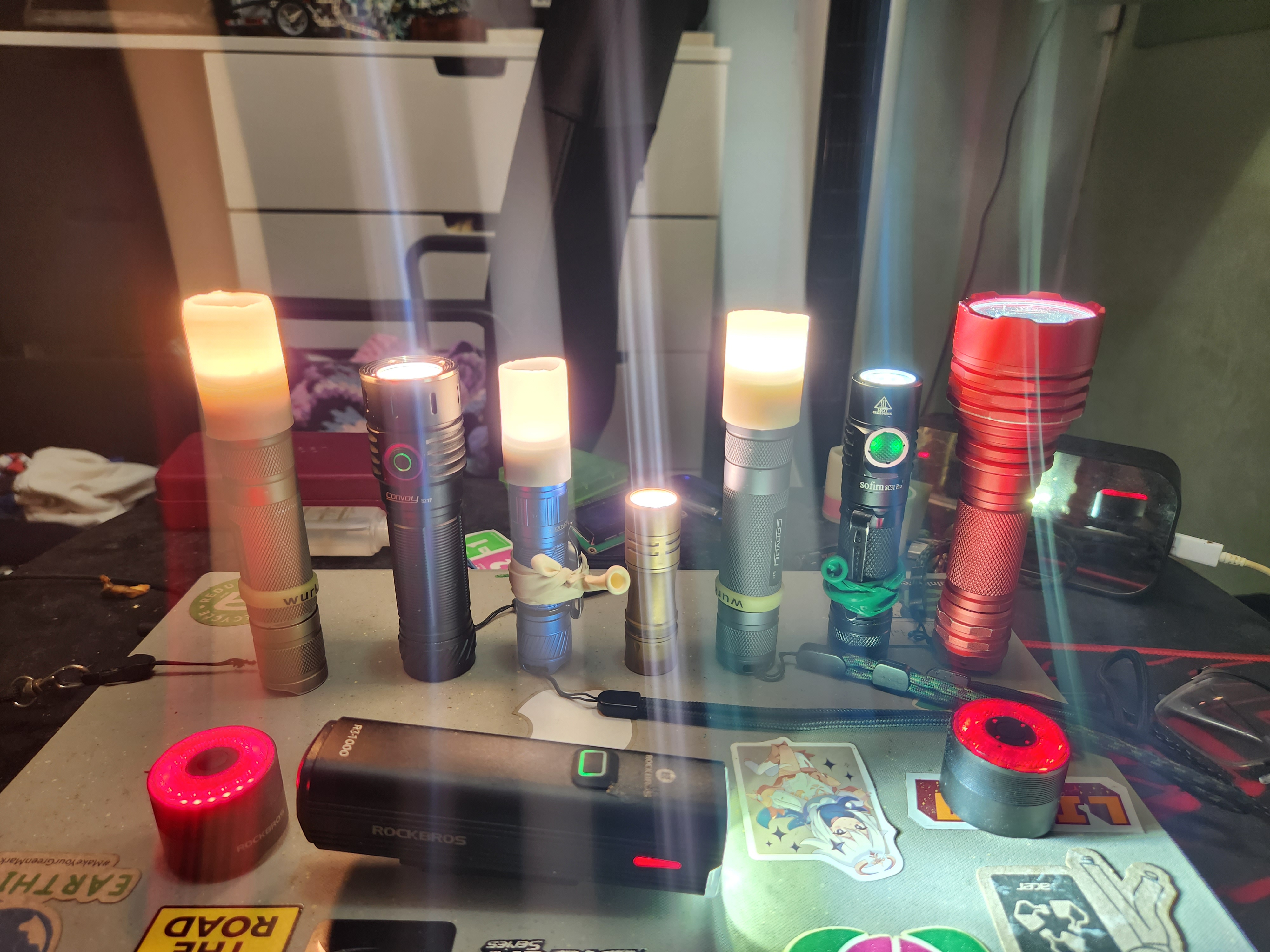
Featured photograph: Flashlights by Simonqq21 / Wikimedia Commons, CC BY 4.0, unmodified original. The featured image illustrates portable lighting; it is not a performance test.
Inline photograph: Reflectors by AlbDRina / Wikimedia Commons, CC BY-SA 4.0, unmodified original.


